Search This Blog

Friday, July 25, 2014

COS

Below is a photo from our recent "close of service" conference in Windhoek, the capitol city of Namibia.
I will still be serving in Namibia for a bit, and am enjoying my final time here. Tremendously grateful for this experience, and to have served for 2 years in this beautiful country!

Friday, June 20, 2014

Namibia and the Past ~

This week, I also wanted to post about the new Namibian museum which recently opened. It is a huge, beautiful structure, nestled between the Namibian Parliament and the old German “Alte Feste,” which was the former national museum. The museum struck an intense emotional note with me. The exhibitions are bold, stark, passionate, and raw. They depict scenes of bloody battles during the Namibian independence struggle as well as the injustices and grave mistreatment of Namibians by the hands of first the German colonizers and then the South African apartheid regime.
My experience in Namibia has fired, shaped, and formed me. It has been real and painful. The pain of the past and the liberation movement are alive in Namibia. I posted long ago about my friend’s parents who were sent to the U.S. for their safety because they were so active in the independence movement. They could have easily been killed at any time, but it was something that they simply accepted. Like so many great leaders throughout history (I think of MLK Jr), they were simply willing to die for their cause. Their vision for Namibia was far greater than any of them as individuals, and they were willing to die for it. Namibians had had enough oppression, injustice, unfairness. They were willing and ready to die so that their children could enjoy the fruits of freedom, could taste the winds of independence, where they were not judged and mistreated and oppressed just because of the colour of their skin.
People have told me the wildest stories about apartheid. Blacks were not allowed into town after a certain time in the evening, and not at all on the weekend. Inter-racial marriages and dating were illegal. Blacks were not even allowed to buy white bread! As I said previously, the black “Bantu” education system was meant to keep blacks down. This mistreatment lingers in the psyche of black Namibians.
As a Peace Corps volunteer, living with the people together in a rural community has enabled local community members to get to know me, and to help them to dispel some of their misperceptions of the U.S. and of white people in general. That has been a huge, unstated goal of mine – to somehow build bridges where and if and how I can. There are huge gaps in understanding and perception between various groups in Namibia. It will take a lot of time, patience, healing and understanding to move forward and to truly transcend this, and to build the necessary bridges, which will ultimately allow Namibia to develop and progress more fully.
Back to the new Namibian museum. I rushed through the exhibits because it was affecting me so strongly, like so many small, internal assaults – upsetting me in a real and visceral manner. Which is right and good – we should pay tribute to the injustices of the past; we should honor and remember and hope that we learn from the errors of our past.
But then as I left, I stopped by the old museum, which is actually an old German fort. Until just a few months ago, there was a German statue there. It was called the “Reiter Denkmal” and was torn down because Namibians felt it honored the German history too much, which the German history in Namibia includes a lot of dark chapters, including the Genocide of many Herero Namibians. So not only was there a space where this monument used to be, a new one had been erected. If you look closely, the new monument depicts scenes of horror. On the front, there is a bronze cast of some hangings. On the back of the monument, are starving skeletons, which depicts the genocide which took place under German rule. Heavy, heavy stuff. I ran from the horror; I skipped up the steps to take a look at what had happened with the old museum building. It has been pretty much abandoned. But I speak German and I can read the inscription on the door. So strange. Still there, untouched, was a plaque in the German language honoring and remember the German troops that died in Namibia during the wars for independence.
There are always multiple perspectives, many sides to every story. But the day left me feeling heavy, disoriented, happy that we are paying tribute to the past, but sad about all of the injustices. I just pray that there is room for hope, for faith, for a brighter tomorrow.
We have to believe that there is. There is no other way.

Peace Corps Namibia Project Advisory Committee Meeting

I was recently invited to attend the Peace Corps Namibia Project Advisory Committee meeting. It was a wonderful experience, meeting stakeholders from the teacher and volunteer level up to senior level officials in the Namibian Ministry of Education. The goal of the Project Advisory Committee is for Peace Corps to improve programming via input from all levels of programming. At the meeting, our Acting Country Director gave a nice presentation which provided some interesting facts about Peace Corps worldwide, which I wanted to share.
Since 2007, the Peace Corps Namibia has taught over 60,000 students! Following independence in 1990, the Namibian government invited the Peace Corps to serve in Namibia. The U.S. Peace Corps responded quickly; a new group of volunteers was on the ground in Namibia just 6 months after independence! What an exciting time to live and work in Namibia! Finally, Namibians tasted the sweetness of freedom and independence that so many had died for, and that many had dreamed about. The goal was to provide qualified teachers to teach English as the new Namibian government had made the decision to change the language of instruction from Afrikaans to English, and to reverse the inequalities and injustices that had been wrought on much of the population during apartheid rule. Apartheid was an extremely oppressive regime which denied blacks, mixed nationality and others their right to education. Blacks were only given a very minimal level of education, never such that they were trained to be managers or to think strategically. Education was wielded as a tool of oppression; only those in power (whites) were granted the privilege of education. Today, we are still working to right these wrongs. Unfortunately, the legacy of apartheid is very much apparent both in the education system and in Namibian society in general.
(Historical context: Afrikaans had been the language utilized under the South African apartheid government, which controlled Namibia from 1919 – 1990. South Africa was fighting on the side of Britain during WWI and defeated German troops in Namibia during 1915 and took control of the country. During the Peace Treaty of Versailles, 1919, the League of Nations officially “gave” Namibia to South Africa. It was under apartheid rule until independence in 1990.) Here in Namibia, the Peace Corps serves in 3-4% of all schools outside of Windhoek (Namibia’s capitol city). The Peace Corps always strive to achieve sustainable international development work. The Namibian Ministry of Education and the United States Peace Corps have partnered to help Namibia achieve Vision 2030, the development goals of the country. There are 146 Peace Corps Volunteers in Namibia; they serve in the health, education and community and economic development programs.
Speaking more generally about the Peace Corps internationally, as many of you reading this probably know, the Peace Corps was founded in 1960 by President John F. Kennedy. The Peace Corps was one of his top priorities. What vision he had; thank you JFK! Today, more than 200,000 Americans have served in 139 countries throughout the world. The Peace Corps has 6 sectors: agriculture, environment, youth development, community and economic development, health and education. The Peace Corps operates at the grassroots level with a bottom-up approach, which is where it is believed that the program can have the greatest impact. The Peace Corps focuses on PEOPLE, not things, and developing people’s capacity and personal agency. The aim is to help others develop the capacity to use their OWN resources and skills to resolve their needs and to improve their own lives.
Our Director mentioned that there are many leaders in the developing world who say they were greatly influenced by Peace Corps Volunteers. This includes the Finance Minister of Ghana who had a Peace Corps Volunteer as a teacher and was greatly influenced by her. On a personal level, this has been one of the highlights for me as well. I have met a few Namibians who just light up when they hear that you are a Peace Corps Volunteer. I met a Namibian man in a taxi a while back and he said that today he is an electrician, but it is only because he had encouragement and inspiration from a Peace Corps Volunteer when he was in school. It was this individual which gave him the motivation and courage to pursue further education.
There are many days when I have wanted to give up! Life is challenging for everyone, and as a volunteer, it is challenging due to a mix of factors: culture, poverty, race relations, gender norms and expectations, etc. However, hearing the man I just mentioned speak about the power that his teacher had on him, and hearing our director talk about the positive effect volunteers can have definitely inspired and reassured me.
These daily struggles of life are of course not limited to the Peace Corps! We he good thing is that we ALL have that ability, that chance, that opportunity, every day and every minute to reach out and touch someone. Peace Corps is a mix of highs and lows – it was just earlier in the week that I was telling a friend at home that nothing really matters! But here I find myself sitting down to write this post and I feel in my heart that in fact EVERYTHING matters. Our thoughts, our habits, our ideas, our treatment of others, how we take care of ourselves and others…it all matters, and it all culminates in the future we shape for ourselves and the future of our Earth and human race. Let’s take that perspective, and let’s treat each other with extra love and care.

Greetings...

I have been posting less frequently lately. Mainly this is due to poor internet access and various struggles associated with living in rural Namibia.
Not having internet access has pros and cons; with one of the major benefits being that it is helpful in getting over tech addictions! (Has anyone seen the “technology loop” on Portlandia?)
As my service slowly draws to an end, I have been reflecting on the experience, and some of my original reasons for joining. They are as follows:
- To serve
- To understand and experience poverty
- To have an “experience from the margins”
- To foster and develop solidarity with those in the developing world, those with whom we primary work with when engaging with human rights and international development work
- To experience living as a minority
- To inform and shape my work in international development and human rights
Today, I read the following quote in Forward Day by Day:
“It’s easy to fall into the trap of thinking everything is scare when God’s abundance is everywhere. In times of real scarcity, love remains in abundance.”
I think back to my life in the U.S. and how often I would complain, or feel sorry for myself, or suffer from my own negative thinking. I am grateful for friends who would often remind me to think in terms of ABUNDANCE not SCARCITY. Here in Namibia, it is so different, the second part of the quote above really resonates here. As I said in a letter home, people here are smiling and open. They do not adopt a victim mentality even though many of them face a lack of material resources. There is material poverty and there is spiritual poverty. While many in the developing world enjoy material wealth, there is often a spiritual poverty that can be present. I am not trying to make blanket statements or to judge or categorize, but rather trying to share comments and observations about what is a complex reality, especially after having lived abroad for two years in a remote and impoverished Namibian village, and when comparing it to the wealth and abundance back in the U.S.
Finally, I wanted to include the following prayer from Alan Seale’s book, Intuitive Living:
The essence of God
Lives in me
The essence of God
Lives in all
Oh Great Spirit,
Prepare me and move through me
As I serve you among
Your people
Bless me and strengthen me
For the journey ahead
Give me sustenance –
All that I need.
And give me time –
Time to sit still and be and listen
So that You might
Create in this world
Through me.
Some photos are also included below…
The ones below of the boys and the wire vehicles are some boys at my school who made the cutest donkey carts out of wire! They are SO creative!

Friday, May 30, 2014

Student Photos, and Powerful Quotes ~

Right now, this is my favorite quote:
"Boundaries between noise and sound are conventions.
All boundaries are conventions - waiting to be transcended.
One can transcend any convention . . .
I can hear your heart beating as clearly as my own.
And I know that separation is an illusion.
You have to do the thing you can't NOT do."
~from the film Cloud Atlas
And these are some of my favorite students:
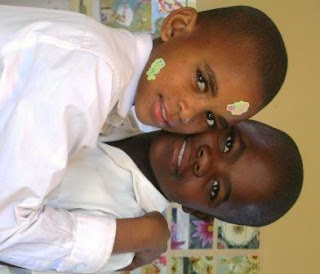
(Apologies for the skewed photos!)
And, in closing, I wanted to also include this poweful Madiba quote:

Friday, May 16, 2014

Zambia, Malawi, Tanzania

Below are photos from my recent holiday. I traveled overland from Namibia to Zambia, Malawi and Tanzania, then back to Namibia.
This was me on a boat tour we took in northern Namibia ~
We also saw a hippo, and a lot of other animals:
As well as the traditional dug-out wooden canoes called "mokoros." They are found in northern Namibia, Botswana, and other surrounding countries . . .
The next stop was Lake Malawi, which is gorgeous. Here are some shots from our room:
Our final destination was Zanzibar, via Dar es Salaam. First, a snap of Dar:
We traveled via ferry from Dar es Salaam to Zanzibar. This is a view from the ferry:
Zanzibar is famous for:
- Stunning beaches:
- Sunsets:
- Spices:
- Seafood:
- Middle-eastern/Arabic inspired architecture and carved wooden doors:
This was me with the puppies at our bungalows:
And I loved this Vespa scene ~
As well as this street art ~
The local beer I love, only for the name!
That was our journey through Zanzibar...
Our travels through Tanzania showed how lush and green the countryside is at the moment. Tanzania has had a lot of rain lately . . .
It was a wonderful trip, a long journey, and incredible to see so much of this region of Africa. Grateful to have had this opportunity! Sending love to you all ~

Friday, May 9, 2014

More to come ~

This is a brief update, with more to come! My PC service continues to go well. Prior to a recent holiday, the focus has been on school, teaching, and many community projects.
An amazing counterpart and I launched an initiative called "Grassroots Soccer," which went very well. This is a partnership between Grassroots Soccer SKILLZ and Peace Corps International. It is a project which uses soccer drills and a club format to work with youth in order to prevent and raise awareness about HIV and AIDS. I love the program! Not only is it very important to stop the spread of aids, but it provides the platform to work with youth in a direct mentoring role. What I particularly like about Grassroots is that you build strong relationships with the kids in your community. Grassroots incorporates "coaches stories" which makes the program more "real" and allows coaches (the facilitators) to share their own life experience so that the youth can learn from you. They are also give the opportunity to work with adults that care about them and that provide positive role models. I have thoroughly enjoyed the program, and it is been a gift and an opportunity to connect more deeply with the young people at my site via Grassroots Soccer.
On another note, my service is coming to an end ~ our group concludes our service around September of this year. This means we are all preparing for departure and working to wrap up our projects and initiatives.
Finally, I am back at site now, but have been traveling recently. I will post photos soon. A friend and I travelled overland all the way from Namibia to Malawi to Zambia to Tanzania, and then back again! A great adventure.
I send all my love to family and friends near and far. I hope this post finds you happy, content, and living life to the fullest.
I am also including a link to a friend of a friend's blog which inspired me today:
http://timetogobald.blogspot.com/2014/04/failing-slowly-and-playing-with-color.html
Sending all my love from Namibia!
"You must do the thing you think you cannot do.”
~ Eleanor Roosevelt