Search This Blog

Friday, July 26, 2013

Mukuni Village

Another highlight of the recent trip to Zambia, where I joined 15 University of Washington students and their professor, was a visit to Mukuni Village and Goat Farm Cooperative. There HIV positive mothers obtain goat milk to keep their babies strong and healthy. I was very impressed by the strong cooperation and collaboration in the community, and by how open the community members were about being HIV positive. The community was also the most progressive that I have seen in terms of women’s empowerment and gender equality as related to women coming out as HIV positive, and their partners supporting then. When I visited Kenya in 2010, and today at my site in Namibia, it is often considered solely the woman’s fault if HIV is brought into a relationship (even if, in reality, it was her husband who contracted HIV first). The women at Mukuni claimed that their partners support them in “starting a new life” and of “living positively” (the concept of living openly, proudly, and unashamedly of being HIV positive, and of embracing a healthy lifestyle and taking ARVs so as to prolong life as long as possible). One woman said, “When you find out you are HIV positive, you receive counseling. This is when you begin a new life – one of living positively, of beginning a new lifestyle.” They admitted that when they came out with their status, they were called a lot of names, and that stigma is still a problem in Zambia. But, they said, “we did not fear.” Their strength and collective support of one another was readily apparent. They also said that by contributing to their community and working together, it “gives them courage, because they know that they are giving back.” I was impressed, heartened, and inspired to see this effective, collaborative and cooperative community group.
Zambia as a whole was beautiful! It is lush and green, and the people are lovely. The towns are vibrant and dynamic, with colorful, creative storefront signs. Compared to Zambia, it also has many more people (Zambia has12 million residents, whereas Namibia has 4 million). I feel fortunate to have visited Zambia, and greatly enjoyed working with the group of students, and learning about places such as Mukuni Village.

Slapped with Racism

I have been meaning to post about my recent trip to Zambia. There was one point during the trip that was a definite “crash” (as in the movie) moment. Our group was visiting a community center in a rural Zambian village. The Director of the center, whom I will refer to as “E” was known, even before we arrived, to have a questionable approach to development, both in terms of power and reflexivity, and in terms of race relations.
This was proven true one day when a group of witnessed pure racism. It was as if we were slapped across the face with it. A group of us were taking a tour with E, when a young (black) Zambian came up to simply ask her a question. She responded with a barrage of insults and put-downs (with the air of a purely colonialist mindset), clearly making him feel tremendously small and embarrassing him painfully in front of us, a group of visitors. E’s actions were both damaging and appalling. They made all of us uncomfortable and angry. Yet at the time….none of us acted. For me personally, I was so shocked by her actions that I shut down. I literally stood there, pretending and hoping and wishing that I could be anywhere but there, that I didn’t have to witness this poor young man’s fundamental human rights and right to dignity being taken away.
Yet…let us not be so quick to judge her; for we all harbor darkness and light. It is our very own societies that have manufactured this inequality, hatred, and distrust amongst various groups of people. This does not mean her behavior was right. There are fundamental human rights that no one has the right to infringe upon, and the young man’s right to lead a dignified and respectable life were, on that day, under attack. But before we judge E and make her out to be the devil, I think we need to disassemble ourselves, our own roles in society, and the societies within which we operate. We need to try to have compassion for her and for ourselves.
In my own village, I do not wish to rationalize anything, but I have come to what I feel is a deeper understanding of the race relations at play. I think certain groups are simply afraid of others, and that they mask that fear with hatred, belittlement of others, and sheer racism. Rather than take the risk that is always inherent in compassion and being open (but that thereby almost always unleashes a torrent of respect, understanding, of meeting the compassion and openness equally), people turn to distrust and animosity. I also believe that this will change – what other choice do we have than to believe that? As I write this, the Trayvon Martin case is at the forefront in the U.S. A grave case of social injustice, and a stunning example of just how far the U.S. has to come in terms of healing and race relations. It is true the world over: there are many oceans to swim through, many deserts to cross, before we find an equilibrium of healing, trust, and an ability to move forward in a just manner.

Shack Dwellers

Also this week, I wanted to share an update regarding the “shack dwellers” association at my site. As you can see in the photos below, the program has really progressed along nicely. (I posted photos a few months ago of the project while it was in process, and there were some glitches in construction along the way). It is exciting and encouraging to see these community members who have pooled together their time, energy and resources to advocate for their rights and to realize their right to safe and secure housing. I think the development is looking quite beautiful with the various colours of paints that the residents are choosing. There is a suburb of another town in Namibia, Okahandja, which is called “Smarties” because the colours of the houses mirror the pastel-coloured candies. I think that this cute little development will be another “mini-Smarties.” Just what our village needs: positive team spirit, morale, supporting one another, resilience, character, and smart and sustainable development.

Sunday, July 14, 2013

Zambia Photos

Below are photos from my recent trip to Zambia. First, a quote to begin the journey…
In Livingstone, we visited Vic Falls:
And Mukuni Village, which includes a goat milk cooperative in which HIV+ mothers can obtain goat milk for their babies free of charge. Most of the moms are on anti-retrovirals, so their babies are HIV free, but the goat milk helps to keep the babies strong, and makes it easier on the mother as she can stop breast feeding at age 6 months.
Below you can see the goats, the program Co-Director and me, a traditional dance performance that the school kids performed for us, and an inspirational quote on the chalk board in a school at the center.
Next are photos from a traditional Zambian village dinner that we had at Professor Ashbaugh’s friend’s house. The meal was one of the best that I have ever had in my life! Below are some typical Zambian village shots:
Colorful shatenges brighten everything up in Zambia…
In Katete, we toured St. Francis hospital. This is a photo of one of the abandoned buildings there. The rest of the hospital was quite nice and modern.
Finally, I went on a game drive in Mfuwe. Below, you can see the giraffes, elephants and hippopotami.
Zambia is stunning and gorgeous, and I feel much healed and revitalized by this journey. I am inspired by the University of Washington students and by Professor Ashbaugh, and I am moved by the simple, yet intentional and harmonious way that I saw many of the Zambians living. You feel much more in tune with nature in such an earthy, peaceful setting.

Saturday, June 29, 2013

Zambia ~

After 19+ hours of bus travel, I am here in Zambia. Tomorrow, I am meeting with a group of students from the University of Washington Bothell. I will be giving a talk about the Peace Corps and my experience in Namibia. I can't wait to meet the group, and to see their amazing professor again, Dr. Leslie Ashbaugh.
So far, Zambia is beautiful! Livingstone is a vibrant, dynamic city set just on the outskirts of Victoria Falls. We will travel to Vic Falls later in the week.
I look forward to hear about the student's reflections on the Exploration Seminar thus far. They are here studying international development. I have heard from former participants on the program that it is life-changing. Knowing Professor Ashbaugh, I am sure that it continues to be so!
I will post photos of the trip soon. Hope you are all well.

Friday, June 28, 2013

"We have only this chance to love – now, today..."

This weekend, I was continuing to read Mark Nepo’s Book Finding Inner Courage. He says, “We have only this chance to love – now, today, to love whoever or whatever is before us. For the mountains will outlast us. The love will outlast us…put down whatever you have carved that is sharp – your mind, your edge, all your prepared responses.”
Later, he talks about a teacher who continued to work with her students even despite the violence and gunshots outside her inner-city classroom doors. The teacher comforted her students, and walked them home after school one day. She says that it is her “job to find something to love in every child.” As a teacher, I find that to be so true. There are 2 kids in my homeroom class that definitely have a learning disability – unfortunately there is not a good system for catering to special-needs students here in Namibia. So I do the best that I can, and I appreciate actually how compassionate the other students are towards these two as well.
It reminds me of some of the inspirational teacher movies that are out there…Dangerous Minds, Freedom Writers, the one with Mr. Vincente in which his AP class in an inner-city school beats all of the odds to get a top score. And I want to be that teacher. Teaching demands that you look beyond the surface and the everyday. It isn’t easy when you are faced with disrespect, classroom management issues, etc. But it is our job to look beyond this. It is kind of like Howard Zinn who says that you have to study history to APPLY it to today’s world, seeking and applying its relevance to today, not merely working within history, observing it as a relic, but actively engaging it. It is the same with teaching, or really with anything – there is the theory and the praxis and the trick is melding and merging the two.
Finally, a love theme surfaced in what I have been reading and listening to. There is, again, Alice Walker’s quote, “Anything we love can be saved.” And in Nepo’s book he says that “God was not interested in my theology, but my capacity to love.” India Arie sings about “the greatest disease in the world is hate…the cure for hate is love.” Love is certainly the most Godly and powerful of forces in the world.
A real test of these reveries will be how and if they apply to the frenetic pace of life in the U.S. As a Peace Corps Volunteer, you think ahead to re-entry and re-integration. Of course it will happen – we as humans are infinitely adaptable. But I don’t think it will be easy, and I certainly want to integrate many of the new lessons and philosophies that I have learned here back into my life in the U.S. I don’t think it is healthy to run so fast and so hard that you have no time to think about where you are going or why. I don’t think anyone benefits when most people in society are over-stressed and over-worked. The key is the elusive middle ground, and seeking balance is truly a lifelong journey.

Kids and Animals…

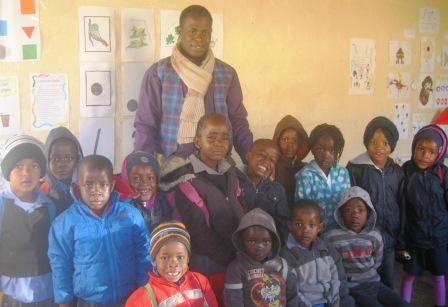
This week, I visited our school’s pre-primary classroom, where I took these adorable shots:
Our pre-primary teacher is a star! He is great with these little ones.
Then, the highlight of the weekend was attending a safari animal game auction. Below is the barn/staging area where all of the animals are contained and kept for viewing while the auction attendees view them through small peephole flaps (so as not to stress the animals).
Next are some of the animals: ostrich, giraffes, antelope ~
Finally, a view landscape shots: scrub and savannah ~
The game auction was quite interesting to observe. The purpose of the sale was primarily for farmers who want to have the game on hand for hunting parties, or for farms which want game on hand for game drives and safaris for tourists. The animals are stunningly beautiful up close, but I was reminded that “this is big business here” many times today. This year, farming and agriculture are taking a huge hit in Namibia because there is a severe drought here. However, tourism and farming are still 2 of the main industries in the country and are in some places still thriving.
From the anthropological perspective, it was interesting to observe who was attending this game auction. The prices of the game were extraordinary – over $40,000 USD for some of the rare antelopes such as roan or sables. Giraffes went for around $1,200 USD. So the people in attendance were mainly wealthy, white farmers. Sharply dressed, powerful people purchasing huge safari animals. It is a huge operation; the barn complex pictured above costs millions of dollars because it has to be safe and secure enough to house very powerful animals until they are ready to be taken away to their new home.
I appreciate being able to compare and contrast these different sides of Namibia. This weekend, two different worlds: today the game auction, tomorrow the township…